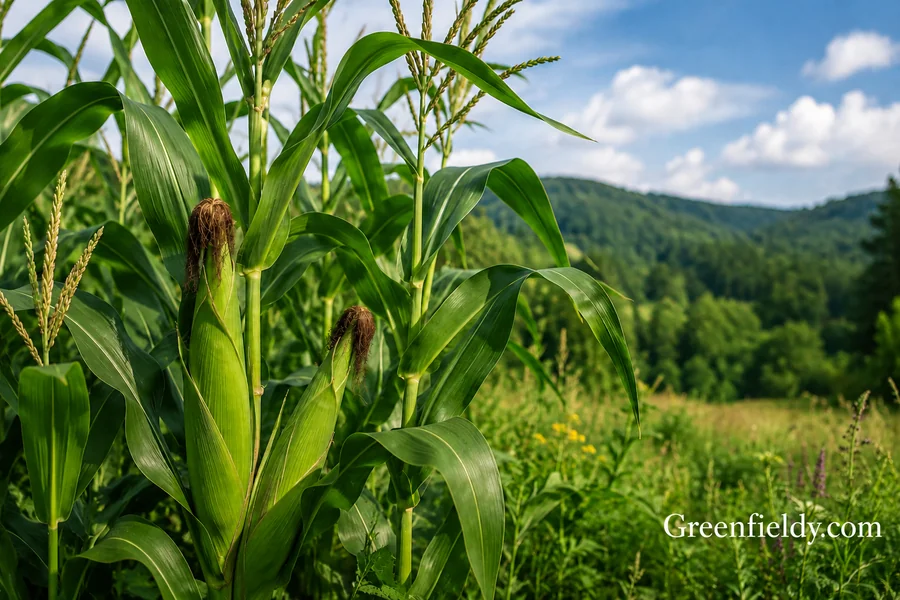
Wild corn is not the sweet full cob that people envision for a summer meal. It typically means teosinte, which is a collection of wild grasses that are closely related to maize. Though it may look very different from the corn found in the store, wild corn has played an important role in the history of food, farming, and plant science.
That’s why many people look for wild corn—because they want a simple answer. Is it edible? Does it occur in nature, or has it been cultivated? Is it the ancestor of corn? The solution begins with teosinte, the wild ancestor that gave birth to the maize that people plant and consume today.
Wild corn isn’t just for history. Scientists are interested in studying it because it could have characteristics that are useful in modern corn for resisting pests, disease, heat, drought, and adverse weather. So, wild corn is relevant to gardeners and students, to farmers and to those who want to know where their food comes from.
What Is Wild Corn?
In most cases, wild corn is a wild grass called teosinte, a close relative of the modern maize plant. Wild corn differs from cultivated corn in a number of ways: it has many branches, small seed clusters, and the kernels are surrounded by a tough outer husk. Wild corn has significance due to its demonstration of maize evolution and the potential to offer beneficial genes for future crop improvement.
| Wild Corn Fact | Quick Answer |
| Common name connection | “Wild corn” often refers to teosinte |
| Relationship to maize | A wild relative and ancestor of modern corn |
| Native region | Mexico and parts of Central America |
| Kernel type | Small kernels covered by a hard casing |
| Why it matters | Helps explain corn domestication and crop genetics |
| Main use today | Research, conservation, and plant breeding |
Why Wild Corn Matters Today
Wild corn can be a living link to the early history of maize. It will provide an explanation as to how people domesticated a wild grass into one of the most cultivated crops in the world.
Modern corn has huge ears, bare ears, and a strong central stalk. The structure of wild corn is quite different. It will usually have more branches and smaller seed pods. The differences illustrate the modifications that occurred in the plant over the years through seed saving and selective breeding.
Early farmers would have stored seeds of plants that were more easily harvested. They might have favored plants that had larger ears, smaller seed shells, and kernels that held together. Those selections over many generations eventually led to the development of domesticated maize.
Wild corn is also important since there is a possibility of loss of diversity in modern crops. If yield, size, or uniformity are set as the priority, then some of the older traits may become less common. Some of the genetic variation in wild corn may be useful, and it can be studied for crop improvement.
Wild Corn vs Modern Corn: What Is the Difference?
Wild corn and cultivated corn are related, but they do not look alike. Once you know what to look for, the differences are easy to notice.
| Feature | Wild Corn / Teosinte | Modern Corn / Maize |
| Plant shape | Many long branches | One main stalk |
| Ear size | Small seed spikes | Large ears with rows of kernels |
| Kernels | Small and hard-covered | Larger and exposed |
| Seed spread | Seeds separate naturally | Kernels stay attached to the cob |
| Harvesting | Difficult and slow | Easier for people to harvest |
| Main purpose | Survival in natural habitats | Food, feed, fuel, and industry |
One of the most significant differences is the structure of the seed. Wild corn has kernels protected by a tough casing. This helps the plant to protect its seed under natural conditions.
Modern maize has exposed grains, which are easier to remove, grind, cook, or plant. This facilitated human beings, but it also made corn more reliant on humans. The seeds of a cultivated corn cob are not as easily spread as the seeds of wild corn are.
Wild corn is designed to survive. Modern corn was designed to be cultivated.
Where Does Wild Corn Grow?
Mexico and Central America are most associated with wild corn. There are various varieties of teosinte that occur in different environments. Some varieties are found in the warm lowlands. Others grow at higher elevations where the temperature may be cooler.
Outside of its natural range, wild corn is not often found in backyard gardens or roadside fields. Corn-like plants that are growing alone can be volunteer corn, ornamental corn, birdseed corn, or another type of grass.
Corn that is cultivated for the benefit of other organisms is different from wild corn. Corn that is grown by volunteers is planted from seeds that have been left behind from a previous planting. Can be found in fields, gardens, or compost sites, where it is not intentionally planted.
Don’t confuse wild corn with heirloom corn. Maize is still grown as heirloom corn. It may look oddly colored or shaped or have a local history, but it is not wild.
How Wild Corn Became Modern Maize
The transformation of wild corn to today’s maize was accomplished through selective breeding. Laboratories were not required for this process to start. They merely collected seeds from plants with valuable qualities.
The larger seeded plants provided more food. It was easier to collect plants whose kernels were not separated. Preparing and eating plants with more accessible seeds were easier.
As time passed, these decisions modified the plant.
Wild corn originated as a branching grass that had small seed structures. Modern maize was a crop that was less branched, larger, and had many more kernels. It doesn’t seem like much of a difference, but wild corn and cultivated corn are very similar.
Wild Corn and Selective Breeding
Selective breeding occurs when individuals select plants for their seeds for the following year’s crop. Wild corn plants were probably chosen for their usefulness by early farmers.
Grain production may be more from a plant that has a bigger ear. A plant with less tough seed cover might be easier to process. Faster harvest of a plant may be possible if the kernel is not broken apart.
These little decisions over many generations.
In the case of wild corn, they demonstrate that agriculture is not just a matter of sowing. It’s also observation; it’s about being patient and picking the characteristics that are best suited to people and places.
Read More: Is Rice a Vegetable
Can You Eat Wild Corn?
Wild corn is technically edible but is not consumed as sweet corn. The kernels are smaller, harder, and covered with a hard outer layer.
Typically, one would not go out and harvest wild corn for consumption. Does not develop the large tender ears associated with sweet corn. It also yields much less food than cultivated maize.
Wild corn is more valuable as a research, conservation, and educational crop than as food. Nonetheless, it sheds light on the food customs associated with corn. Corn may be dried, ground, cooked, fermented, popped, or used in the production of a variety of food products.
Never eat a plant that looks like corn without knowing what it is! Identifying plants correctly is important. The plant may resemble wild corn but can actually be another plant.
Is Wild Corn the Same as Teosinte?
In many cases, yes. Teosinte is sometimes referred to as ‘wild corn.’ The most commonly associated wild relative with maize is teosinte.
But the term “wild corn” can be misleading. In some uses it is misapplied in reference to the volunteer corn. Others plant it for old field corn varieties or for decorative corn plants.
The appropriate vocabulary clarifies the topic.
Wild Corn, Teosinte, and Other Corn Terms
| Term | Meaning | Truly Wild? |
| Wild corn | Often used to describe teosinte | Usually yes |
| Teosinte | Wild relative of maize | Yes |
| Volunteer corn | Corn growing from leftover seed | No |
| Heirloom corn | Traditional cultivated variety | No |
| Ornamental corn | Corn grown mainly for decoration | No |
| Field corn | Cultivated corn grown for feed or processing | No |
When discussing plant science, teosinte is the more accurate term. When writing for a general audience, wild corn is easier to understand and often matches what people search for online.
Why Researchers Study Wild Corn
Importance of wild corn: carries genetic diversity. That is, it may have characteristics less frequently found in modern corn varieties.
There may be instances when some populations of wild corn are better able to cope than heavily bred crops. Corn research examines wild corn for disease resistance traits, pest resistance, flooding tolerance, cold tolerance, or drought response.
This doesn’t imply that wild corn is necessarily superior to corn today. It just has other characteristics. Some plant adaptation that is good for a wild plant may not necessarily be successful in a large farming operation.
In natural habitats heavy branching can be beneficial to the growth of wild corn. However, it might not be applicable to a commercial field in which farmers require plants to develop rows of ears and large ears.
It is not the purpose of this activity to create a wild corn type. The ultimate aim is to learn about desirable characters and apply them properly in crop improvement.
Can You Grow Wild Corn at Home?
Properly identified seeds of wild corn can be sown where it is legal and appropriate to the local climate. But cropping wild corn is a process very different from that of growing sweet corn.
Teosinte can be rather vigorous and branching. Requires sunlight, space, and time to mature. Also, it can cross-pollinate with nearby corn if pollination is simultaneous.
Please review local seed regulations and agricultural laws before planting wild corn. Wild relatives to crops can be protected or controlled in some areas.
Read More: Cauliflower Shortage Explained
Wild Corn Growing Checklist
Use a known and trusted supplier for wild corn seed.
- Ensure seed is identified correctly as teosinte.
- Select a sunny spot that has sufficient space for branching.
- Use well-drained soil.
- Water young wild corn plants during dry periods.
- If the possibility of cross-pollination exists, separate wild corn from nearby maize crops.
- Note plant height, branching, flowers, and seed clusters.
- If you are uncertain about the plant and the local rules, don’t save seeds.
Wild corn, available for cultivation, can be a school project, garden experiment, or learning activity. It is most suitable for observation and education purposes and not as a food crop.
Wild Corn in Food and Farming History
Wild corn is more of a long story. Maize was not originally a uniform crop. It was developed by Indigenous farmers in the Americas.
The farmers, after a period of time, chose maize for numerous purposes. Specific cultivars were more suitable for grinding. Others served the need of popping, boiling, roasting, or dough-making. Corn types were different in different climates and communities.
It is apparent from this story that this is where it all started with wild corn. It exhibits the original morphology of the plant before the breeding of traits for larger heads and harvestability.
This history is not to be looked at as a simple science fact. For thousands of years, corn has been at the heart of food culture, agricultural practices, and traditional knowledge. Wild corn provides a glimpse into this long connection between people and plants.
Common Myths About Wild Corn
Myth: Wild Corn Looks Like Small Sweet Corn
Not usually. Wild corn has more branches and much smaller seed structures. It does not produce full supermarket-style cobs.
Myth: Every Corn Plant Growing Alone Is Wild Corn
No. A plant growing without being planted may be volunteer corn. It could come from bird feed, compost, dropped seed, or a previous crop.
Myth: Wild Corn Is Better for Eating
Wild corn is not better for easy eating. Its kernels are small and hard-covered. Modern corn was bred for larger ears and more accessible kernels.
Myth: Wild Corn Is a New Discovery
Wild corn has been known for a long time. It remains important because it helps researchers understand maize domestication and crop diversity.
Myth: Wild Corn Has No Value Today
Wild corn still matters. It supports research into plant genetics, conservation, and future crop breeding.
Read More: Pea Shoots Benefits
FAQs
What is wild corn called?
Wild corn is commonly called teosinte. Teosinte is a wild grass closely related to modern maize.
Is wild corn edible?
Wild corn can be edible, but its kernels are small, hard-covered, and not usually eaten like sweet corn.
Did modern corn come from wild corn?
Modern maize developed from teosinte through generations of selective breeding by early farmers in Mexico and Central America.
What does wild corn look like?
Wild corn often has many branches, narrow seed spikes, and small kernels protected by a hard outer casing.
Can wild corn cross-pollinate with regular corn?
Wild corn and cultivated corn can cross-pollinate when they flower at the same time because they are closely related.
Is wild corn the same as heirloom corn?
No. Wild corn usually refers to teosinte. Heirloom corn is cultivated maize that has been maintained by growers over time.
Why is wild corn important?
Wild corn helps scientists study maize history and may contain traits that support future crop breeding and conservation work.
Does wild corn grow in the United States?
Some teosinte relatives may be grown in research settings, but true wild corn is mainly associated with Mexico and Central America.
Final Thoughts
The wild corn isn’t just an ancient form of maize. It’s a reminder that food crops have long histories, histories of people, climate, land, and judicious seed selection.
Wild corn is an interesting plant to watch for gardeners. It becomes easier for students to comprehend domestication. Wild corn may contain valuable characteristics that can be applied to future crops by researchers.
When you next see a corn cob, consider the kernels. Wild corn is a witness to the development of one wild grass into one of the world’s important food crops.
About the Author