
You can more easily learn how to plant carrot seeds if you concentrate on the essential details. Carrot seeds are very small. Requires loose soil, light watering, and patience. Once you’ve mastered these fundamentals, you can produce a straight and tidy line of fresh roots from a tiny seed packet.
Many gardeners miss out on carrot seedlings. Dry soil, hard-crusted ground, deep planting, and weeds are the common causes. This guide will lay out the steps you will need to take to plant carrot seeds without those problems that you will be facing from the very beginning.
How to Plant Carrot Seeds
Carrot seeds should be planted in loose, stone-free soils that are in full sun to learn how to plant carrot seeds. Drill a shallow hole (1/4 – 1/2 inch). Seed sparingly and lightly, and maintain an even upper layer of soil moisture until germinated. Thin out seedlings to 2-4 inches apart when well established.
| Carrot seed planting factor | Best practice | Why it matters |
| Planting location | Full sun | Helps roots develop well |
| Soil | Loose and free of stones | Reduces split and forked roots |
| Seed depth | ¼ to ½ inch | Small seeds struggle when planted too deep |
| Row spacing | 6 to 12 inches | Gives room for weeding and airflow |
| Final plant spacing | 2 to 4 inches | Allows roots to widen |
| Watering | Keep surface moist | Supports slow germination |
When to Plant Carrot Seeds
The first step in how to plant carrot seeds is deciding on the proper time to plant. Carrots do not grow well in warm weather. Plant them in the early spring, when the soil is suitable for tillage. If harvesting in the fall, plant a new crop in late summer after the hottest weather sets in.
If possible, avoid waiting for hot weather. Excessive heat will slow germination and create a difficult growing environment. In warm areas, fall crops might be easier to grow than late spring crops.
It is good to sow a short row every two or three weeks. This technique provides you with carrots for a longer time rather than a single harvest.
How to Plant Carrot Seeds in Spring
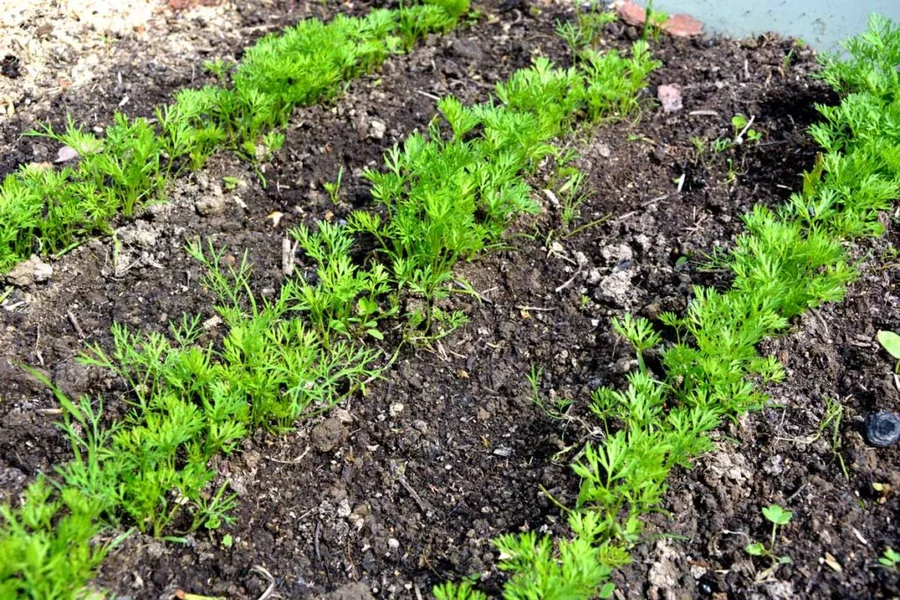
To plant the carrot seeds in the spring, wait for the ground to stop freezing and the planting bed to be muddy. Only dig the soil when it crumbles in your hands rather than forming clumps. Carrots may take longer to sprout in cold soil, but they are better adapted to cool soils than are some vegetables in the summer.
If heavy rainfall, high winds, or pests are a problem in the garden, consider using a row cover. Prune it out as necessary for weeding and thinning.
How to Plant Carrot Seeds for a Fall Harvest
To determine the date to plant carrot seed for the fall, back-calculate from the first frost date. Select a variety with a sufficient number of days to maturity prior to the advent of severe cold. Water regularly during the late summer, as soil may dry rapidly at this time.
Carrots from the fall season tend to be flavorful, as they are ready to harvest during a cooler season. Do not allow a dry spell to hinder early growth and keep the bed clear.
Choose the Right Place Before You Sow
One of the critical factors in planting carrot seeds is the choice of the planting bed. Choose a location with at least six hours of direct sunlight; carrots will grow in light shade, but in full sun, they will grow better and have more reliable roots.
Do not have fresh manure or a heavy nitrogen feed in the same place immediately prior to sowing. Excessive nitrogen can promote leafy growth rather than root growth. It will also cause branching roots.
Raised beds are suitable for planting carrot seed since it is possible to control the soil texture. Short varieties of carrots also grow well in a deep container. Pots should be made with round or small-rooted varieties, not long varieties, which require more depth.
Read More: Labor Shortage in Cherry Harvesting
Prepare Loose Soil for Straight Carrots
A good soil prep determines a lot of the outcome. Carrot seeds are planted by loosening the soil 8 to 12 inches deep. Clear rocks, old roots, hard clumps, and chunks of wood. A carrot root may split or bend when it is pressed between two small rocks.
Add finished compost to low-quality soil. Avoid using high amounts of fresh manure. Rake the upper few inches so that the surface is fine and level. This will allow for easier shallow line formation and even seeding coverage.
| Soil problem | What it can cause | Simple fix |
| Stones or debris | Forked roots | Remove them before sowing |
| Heavy clay | Slow sprouts and poor root shape | Add compost and grow in a raised bed |
| Hard crust | Seedlings cannot push through | Keep soil lightly moist |
| Fresh manure | Extra leaf growth and split roots | Use aged compost instead |
| Uneven surface | Uneven seed depth | Rake the bed smooth |
How to Plant Carrot Seeds Step by Step
Here is how to plant carrot seeds in a way that keeps the work simple:
- Make straight rows approximately 6 to 12 inches apart.
- Use the edge of a hoe, stick, or rake to make a shallow hole.
- Lightly water the drill before planting seeds.
- Rare seeds along the row.
- Cover with a thin surface layer of soil, ¼ to ½ inch thick.
- Lightly press the soil over the seeds so that the seed makes contact with the soil.
- Use soft spray to ensure that seeds will not be washed away.
- Maintain moistness of the upper layer until seedlings emerge.
- It is a good idea to label the row, as carrots may take some time to emerge.
This method for how to plant carrot seeds is simple, but it takes a careful hand. Do not worry if the seeds land close together. You can think later. Trying to place every seed at the final spacing often takes too long.
Some gardeners mix seed with dry sand to spread it more evenly. Others use seed tape. Both options can help when you want less thinning. Still, the basic method of how to plant carrot seeds stays the same: shallow sowing, light covering, and steady moisture.
How Deep Should You Plant Carrot Seeds?
The first question that comes up in people’s minds when they ask how to plant carrot seeds is depth. Plant ¼ – ½” deep. Seeds are small, and a shallow planting is used. They could not have enough energy to make it to the surface if they are buried too deep.
Do not use coarse clods but fine soil to cover the row. The soil should be able to retain water but not be compacted. Just a gentle touch will suffice.
How Far Apart Should Carrot Seeds Be Planted?
Carrot seed spacing at planting time is not critical. Spread seeds out thinly in the drill. Once sprouted, thin plants to allow 2-4″ space between carrots.
For baby carrots and small carrots, use the end that’s closer. Provide more space for storage types and larger varieties. Spending helps keep roots from becoming too crowded and aids in easier harvesting.
Keep the Soil Moist Until Germination
Watering is the most critical follow-up action when planting carrot seeds. Carrot seeds are slow to sprout. The surface of the soil should not be allowed to become dry during the period. Water so that the surface remains moist.
A strong stream can move seeds or form a crust. Water with a watering can that has a rose head, use a soft hose setting, or use light mist. During dry and windy days, inspect the bed every day.
Place a board on top of the row for a few days to retain moisture until the sprouts appear, then remove the board each day to inspect the sprout growth. Remove as soon as seedlings appear. Keep an eye out for anything heavy on the row after germination.
Thin Seedlings Without Damaging the Row
Thinning is a compulsory step in the seed planting of carrots. Plants growing together for space. This may lead to thin, bent roots and small carrots.
Wait for seedlings to be easier to manage. Then pinch off any surplus to allow 2-4 inches of space for the strongest plants. Pulling will disturb roots around the plants. It’s neat to snip unwanted seedlings right at ground level with scissors.
Water early in the evening or after watering to thin it. This will decrease stress to the plants. Remove the pulled seedlings rather than leaving them next to the row.
Read More: How to Grow Mango From Seed
Weed Early and Feed Lightly
The knowledge of planting carrot seeds involves taking care of weeds. The carrot seedlings are skinnier and slower than they’d like to be at first. Covering weeds can occur prior to detection. Mow or pull weeds when small and easily identified.
Install with a shallow, small tool between rows. Early growth of carrot roots is near the surface. They are susceptible to damage by deep cultivation.
Do not over fertilize after planting. Carrots generally require few other inputs when growing in average soil with prior compost application. Too much nitrogen will produce a tall green top with not enough root.
Common Problems After Planting Carrot Seeds
Even when you know how to plant carrot seeds, a few issues can show up. The good news is that most have a clear cause.
| Problem | Likely cause | What to do next time |
| Few seedlings | Soil dried after sowing | Water lightly and often until sprouting |
| Uneven row | Seeds were covered unevenly | Rake a smoother seedbed. |
| Forked carrots | Stones, clods, or fresh manure | Prepare soil deeper and cleaner |
| Small carrots | Crowding or shade | Thin plants and improve sunlight |
| Bitter roots | Heat or uneven watering | Keep moisture steady and harvest on time |
If your first row looks thin, do not give up. With how to plant carrot seeds, the second sowing is often better because you understand how quickly your own soil dries and how it behaves after rain.
How to Plant Carrot Seeds in Containers
How to plant carrots in containers can be used when the soil you have in your garden is rocky or heavy. Use a pot that is at least 10-12 inches deep for short carrots. Long-rooted varieties require a deeper root zone.
Do not use yard soil as a potting mix. Make drainage holes a priority. Sow as you would in beds and then thin out to the final spacing. Moisture loss will be quicker in containers, so monitor frequently.
Place in a sunny area and rotate the pot every few days if one side is not getting as much sunlight. This little habit can keep growth steady.
Harvesting After You Plant Carrot Seeds
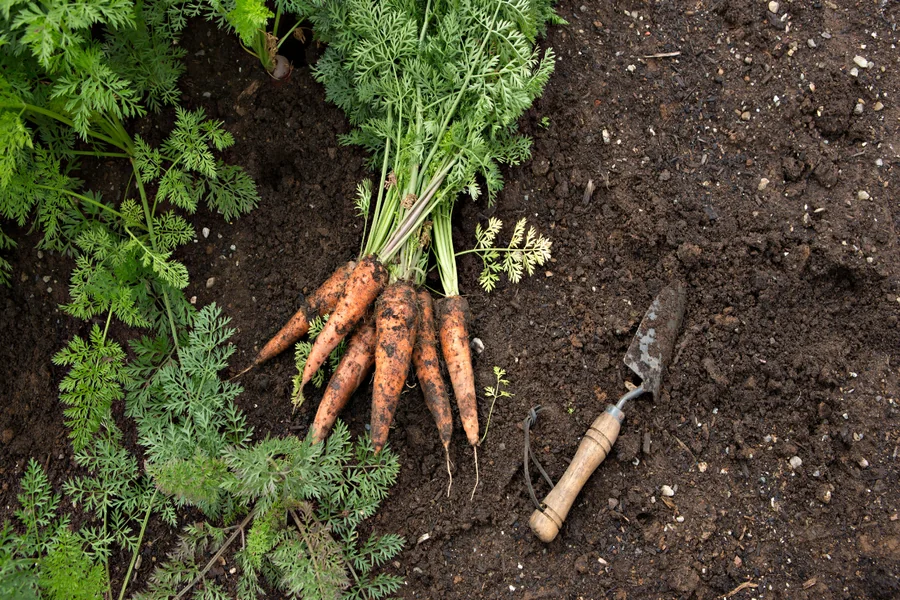
Understanding seed planting techniques also allows you to plan your harvest. Because of the seed packets containing days to maturity, the best indicator of maturity is the carrot shoulders. Pull some soil away from the top of one root to inspect the width of the root.
Before taking all of the carrots in a row, pull a test carrot. If the size is correct, fork up the soil and remove the roots. Avoid excessive pulling from dry and compacted soil. The top can be broken off.
To get the best texture, pick before roots get too big. Late crops can be left in the bed for a bit longer in cool weather, as the flavor may be enhanced.
Helpful Tips for Better Carrot Germination
These quick reminders make how to plant carrot seeds easier:
- Use fresh seed when possible.
- Sow shallowly, not deeply.
- Keep the seed row moist every day until sprouts appear.
- Remove weeds while they are tiny.
- Thin plants so roots have space.
- Sow small batches for a longer harvest.
- Keep the soil loose and free of stones.
Read More: Green Onion Shortage
Final Thoughts
The easiest method for learning how to plant carrot seeds is to keep things simple! Choose loose soil. Sow shallowly. Keep the row moist. Thin early. Allow roots to develop after that.
After learning to start carrot seeds, you can do this throughout the season and pick the carrots as you need them. A small, well-designed row could yield a lot more than meets the eye.
FAQs
Do carrot seeds need to be soaked before planting?
No. For how to plant carrot seeds, soaking is not required. Fresh seed, shallow planting, and steady moisture matter more than soaking.
Can I plant carrot seeds directly in the garden?
Yes. Direct sowing is the standard approach for how to plant carrot seeds because carrot roots do not like being moved after they start growing.
How long do carrot seeds take to germinate?
For how to plant carrot seeds, expect sprouts in roughly one to three weeks. Weather, soil warmth, and moisture can make the process faster or slower.
Why are my carrot seeds not coming up?
When how to plant carrot seeds does not work at first, dry surface soil, deep planting, soil crust, old seed, or heavy rain are common reasons.
Can you grow carrots from seeds in a raised bed?
Yes. A raised bed can make how to plant carrot seeds easier because it provides loose soil and better control over stones, moisture, and drainage.
Should carrot seedlings be thinned?
Yes. In how to plant carrot seeds, thinning is needed so each remaining root has enough room to grow to its proper size.
A Quick How-to-Plant-Carrot-Seeds Checklist
Use this how-to-plant-carrot-seeds checklist before you begin. It keeps the work focused and helps you spot simple mistakes early.
- For how to plant carrot seeds, start with a sunny bed.
- For how to plant carrot seeds, remove rocks before making rows.
- For how to plant carrot seeds, keep the drill shallow.
- For how to plant carrot seeds, cover seeds with fine soil.
- For how to plant carrot seeds, water with a gentle spray.
- For how to plant carrot seeds, check the row every day during germination.
- For how to plant carrot seeds, pull weeds before they grow large.
- For how to plant carrot seeds, thin seedlings rather than leaving them crowded.
- For how to plant carrot seeds, sow another small row later for a longer harvest.
About the Author