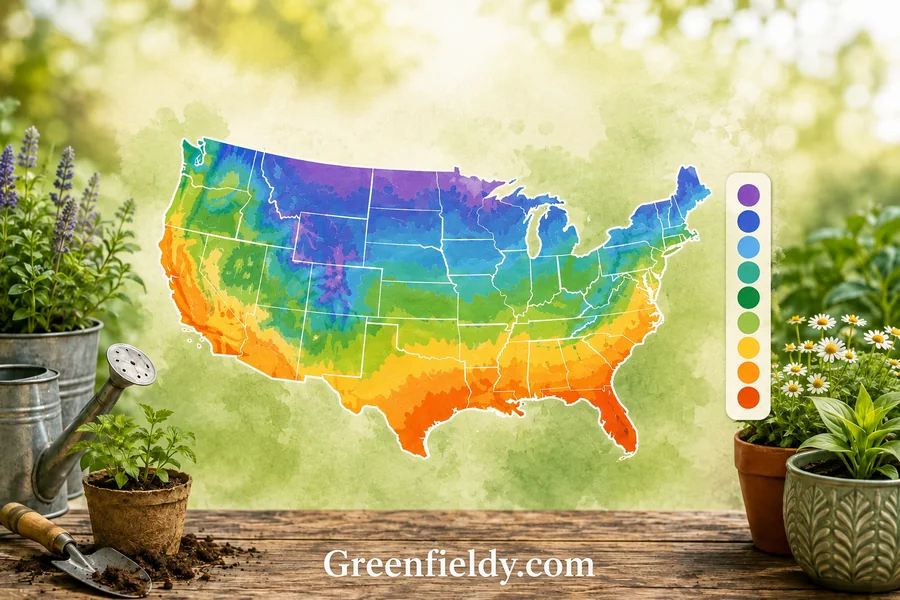
You might have purchased a plant tag with the zone classification “Zones 4-8” and wondered what it meant to you.You may have purchased a “Zones 4-8” plant tag and wondered what it meant to you. Answering what USDA zone am I in is the first step every gardener needs before buying a single seed or shrub. It lets you know if that lavender plant will live through the winter or if it will die on the first frost.
Your USDA zone is based on your area’s average lowest winter temperature. Now you’ll know it, you can shop smarter, plant on time and save money on plants that will never last through January.
This is all you need to know to identify your zone, understand it & use it in your garden.
What USDA Zone Am I In? Quick Answer
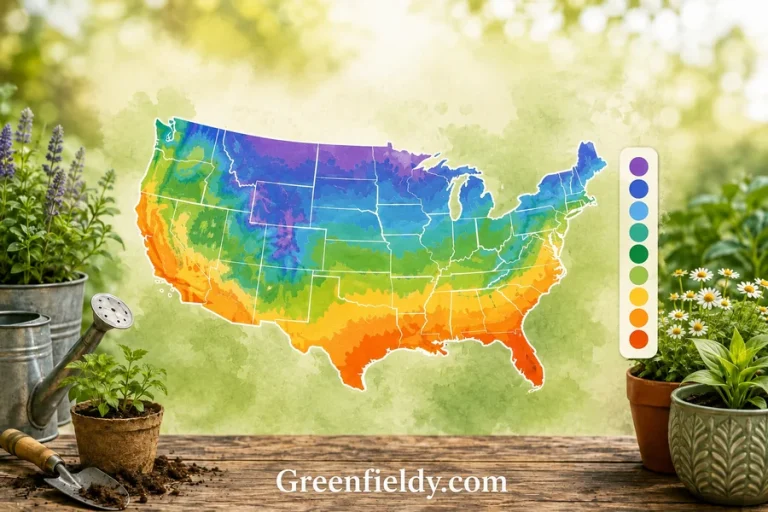
To find your exact zone, go to the official USDA Plant Hardiness Zone Map and enter your ZIP code into the search field and your exact zone will appear immediately. The United States has 13 temperature zones numbered 1–13 according to the temperature of the coldest recorded in each during a 30-year period. Zone 1 is the coolest. Zone 13 is the warmest zone. Every zone is also divided into “a” and “b” to help to be more exact with the reading.
Here is the short answer to the question. Now, let’s get into the nuts and bolts of what it is and why it is even more important than most gardeners realize.
What Is a USDA Hardiness Zone, Really?
The USDA hardiness zone is a geographical zone that depends on the extreme minimum temperatures of the winter season. In simple terms, it is the temperature that is experienced on a representative bad night during winter, as opposed to the typical temperature during the summer and average temperature.
Each zone is 10°F wide. That’s down to 5°F with half zones (“a” and “b”). Zone 7a and Zone 7b are considered to be Zone 7, but 7b is approximately 5 degrees warmer than 7a.
The map is from the USDA, which was developed from thousands of weather stations throughout the United States. It is the latest version, released in 2023 and based on climate information for the period 1991-2020, and supersedes the previous 2012 map. For many regions the temperatures were slightly warmer in this update – this is important to note if you are comparing plant advice from an older gardening book.
Why Your USDA Zone Actually Matters
Skip this step and you’re gardening blind. Here’s what your zone controls:
- Which perennials survive winter. Annuals don’t care about your zone since they die off anyway. Perennials, trees, and shrubs absolutely do.
- What to plant and when. Cold-hardy crops go in earlier. Tender crops wait until frost risk passes.
- How to read plant tags and seed catalogs. Almost every perennial label lists a zone range. If your zone falls outside it, that plant is a gamble at best.
- Whether you need extra protection. Gardeners near the edge of a zone often use mulch, cold frames, or raised beds to buy their plants a little insurance.
Knowing your zone doesn’t guarantee a perfect garden. But planting without it is like packing for a trip without checking the weather.
Read More: Plant Swap Ideas
USDA Hardiness Zones at a Glance
| Zone | Average Minimum Winter Temp | Example Region |
| 3 | -40°F to -30°F | Northern Minnesota |
| 5 | -20°F to -10°F | Upstate New York |
| 6 | -10°F to 0°F | Kansas, Ohio |
| 7 | 0°F to 10°F | Virginia, Oklahoma |
| 8 | 10°F to 20°F | Georgia, North Texas |
| 9 | 20°F to 30°F | Central Florida, Southern California |
| 10 | 30°F to 40°F | South Florida |
| 11 | 40°F to 50°F | Hawaii, Puerto Rico |
This is a general guide, not a substitute for looking up your exact ZIP code. Elevation, coastal proximity, and even city heat can shift your real-world zone by half a step in either direction.
How to Find Your USDA Zone (3 Simple Steps)
- Go to the official USDA map. Visit planthardiness.ars.usda.gov and use the ZIP code search box.
- Enter your ZIP code. The tool pulls the exact zone and half-zone for your address, not just your state or region.
- Write it down and use it. Keep your zone handy when shopping for plants, whether you’re at a nursery or ordering online.
That’s it. No guesswork, no outdated books required.
Does My USDA Zone Ever Change?
Yes, but not because your climate changed overnight. The map is periodically updated approximately every 10 years as new temperature data becomes available. Many areas moved to a warmer half-zone with the 2012 map to the 2023 map, which is not a change over one night but is based on 30 years of station data changes. Please remember to verify your zone (if using an old map or old plant tag) for accuracy with the current map.
USDA Zone vs. Frost Dates: Know the Difference
This is a common mistake made by many new gardeners. Your zone in the USDA zone map provides you with information about what will survive winter in your area. Frost dates help determine when to plant in the spring and before the fall frosts arrive.
Imagine that – your zone selects the plants, your frost dates select the time! You must have both to plan a garden properly. For example, a tomato plant is not a zone-rated plant at all, it is a last frost date-dependent plant.
Read Also: Garden Cover for Winter
Common Mistakes Gardeners Make With Zones
- Ignoring microclimates. You can change your effective zone while keeping your official zone the same by using a south-facing wall or a low spot that will trap cold air.
- Purchasing based on summer heat rather than winter cold. USDA zones do not indicate the ability to withstand your summer weather. If you have heat stress problems, research heat zones on their own.
- Relying on the old plant tags. Older and cooler zone maps may be referenced in a tag prior to 2023.
- Assuming state-wide accuracy. California and Texas are examples of large states that have multiple zones. Your city is more important than your state.
The Bottom Line
It only takes a minute to know the answer to “what USDA zone am I in”, and that will save you from unnecessary plant purchases that would not have survived the winter. Search your ZIP code, record your zone and compare it to all perennial, shrub or tree purchases. Add your local frost dates and you have the two most important pieces of information for a garden that produces produce!
FAQs:
What is my USDA hardiness zone?
Enter your ZIP code at planthardiness.ars.usda.gov to get your exact zone. Zones range from 1 (coldest) to 13 (warmest), based on average winter low temperatures.
How many USDA zones are there?
There are 13 main zones, each split into an “a” and “b” half-zone, making 26 zone categories total across the United States.
Is the USDA zone map still accurate in 2026?
Yes. The most recent map was released in 2023 using 1991-2020 climate data, and it remains the current standard used by nurseries, seed companies, and gardening resources.
Can two people in the same city have different zones?
Yes. Elevation changes, urban heat, and nearby water can shift a specific address by half a zone even within one city.
Does my USDA zone tell me when to plant?
Not directly. Your zone tells you what can survive winter in your area. For planting timing, you also need your local first and last frost dates.
What’s the difference between USDA zones and AHS heat zones?
USDA zones measure winter cold. AHS heat zones measure the number of days above 86°F each year. Gardeners in hot climates often check both.
Read More Articles: How to Grow Herbs Indoors
About the Author